
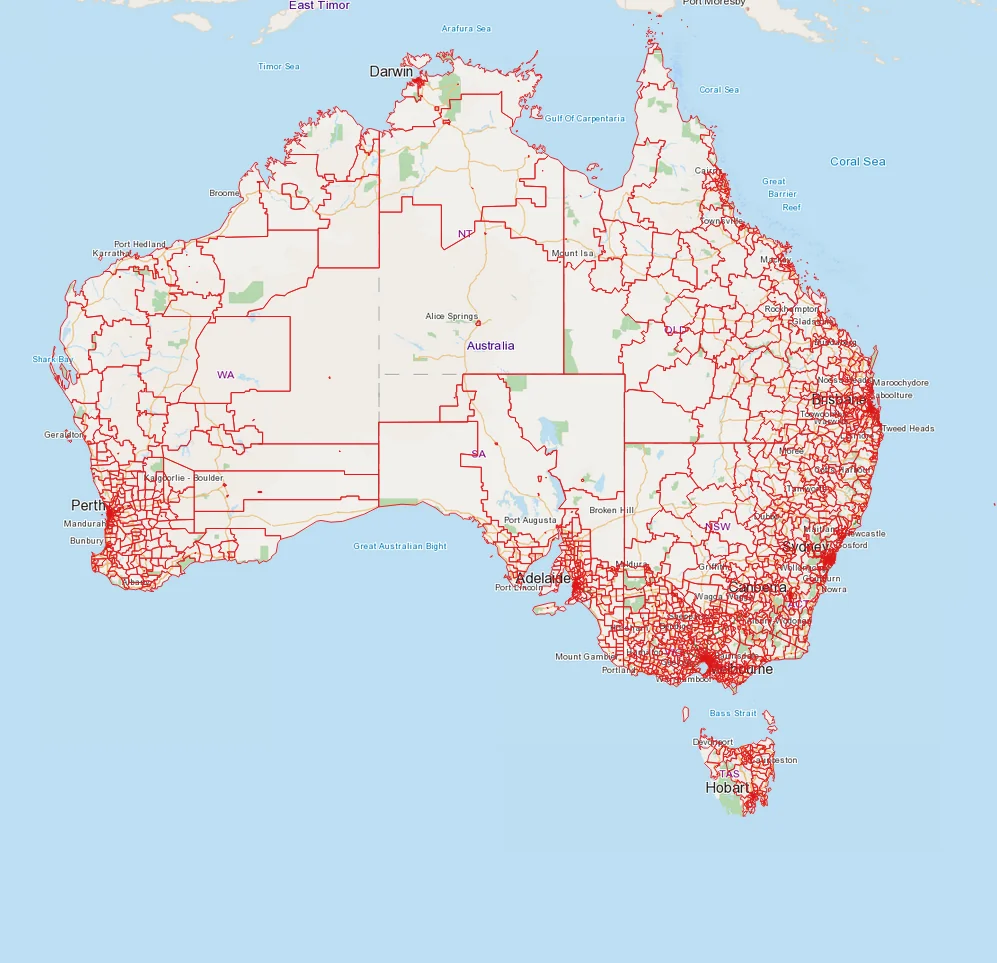
Have you ever wondered how a letter or package can travel thousands of kilometers across Australia and still arrive at the correct address? One small but important part of the process is the Australian postcode.
Postcodes may look like simple four-digit numbers, but they play an important role in sorting and delivering mail throughout the country. From busy cities such as Sydney and Melbourne to remote communities in Western Australia and the Northern Territory, postcodes help organize Australia’s enormous postal network.
Understanding how Australian postcodes work can also be useful when shopping online, sending packages, moving to a new address, or filling out an Australian address form.
What Is an Australian Postcode?
An Australian postcode is a four-digit numerical code used to help identify geographic areas and organize mail delivery.
Australian postcodes generally look like this:
2000
Unlike Canadian postal codes, which combine letters and numbers, Australian postcodes use numbers only.
A complete Australian address might look like:
Example Street
Sydney NSW 2000
Australia
The postcode helps postal services determine where the mail needs to go and how it should be processed.
Why Are Postcodes Important in Australia?
Australia is a huge country with a relatively small population spread across large distances. Mail may need to travel from one major city to another or from a metropolitan area to a remote regional community.
Without an organized addressing system, sorting millions of letters and parcels would be much more difficult.
Postcodes help by providing an additional geographic identifier.
They can help postal systems:
- Sort letters and parcels
- Route mail toward the correct region
- Identify delivery areas
- Process large volumes of mail efficiently
- Support automated sorting systems
- Improve address accuracy
- Calculate shipping and delivery information
In simple terms, a postcode acts like a shortcut that gives the postal system useful information about where an address is located.
How Australian Postcodes Are Structured
Australian postcodes contain four digits.
The first digit generally provides a broad indication of the geographic region.
For example, postcode ranges are associated with different states and territories. Some common starting ranges include:
- 1xxx — New South Wales, Australian Capital Territory, and some other special postal areas
- 2xxx — New South Wales and the Australian Capital Territory
- 3xxx — Victoria
- 4xxx — Queensland
- 5xxx — South Australia
- 6xxx — Western Australia
- 7xxx — Tasmania
- 8xxx — Northern Territory
The system is more detailed than simply assigning one number to each state. Individual postcode ranges can identify particular cities, suburbs, regions, or other delivery areas.
City Postcodes Can Be Very Different
One of the interesting things about Australian postcodes is that a single city or metropolitan area can contain many different postcodes.
For example, Sydney does not have one postcode for every address.
Different suburbs can have different codes.
This means that knowing the city alone is usually not enough to determine the correct postcode. The suburb and street address are important.
The same principle applies to Melbourne, Brisbane, Perth, Adelaide, Canberra, Hobart, and other Australian cities.
Postcodes and Suburbs
Australian postcodes are closely connected with suburbs and localities.
When entering an address online, you may see fields such as:
Street Address
Suburb
State/Territory
Postcode
Each part provides different information.
For example:
25 Example Road
Richmond VIC 3121
Here, “Richmond” identifies the suburb or locality, “VIC” identifies Victoria, and “3121” is the postcode.
Together, these details provide a much more precise destination than the postcode alone.
How Postcodes Help Automated Mail Sorting
Modern postal operations process enormous numbers of letters and parcels.
Instead of having every item manually examined and routed from beginning to end, postal systems can use automated technology to read address information and help sort mail.
The postcode is particularly useful because it provides a standardized numerical identifier.
When the postcode is clearly written or printed, sorting systems can use it as one of the clues for directing an item toward the appropriate processing and delivery area.
This can make mail handling faster and more efficient.
Postcodes Are Useful for More Than Letters
Many people associate postcodes with traditional letters, but they are also important for parcels and modern e-commerce.
When you buy something online, an Australian website may ask for your:
- Full name
- Street address
- Suburb
- State or territory
- Postcode
The postcode can be used to help determine shipping options, delivery estimates, service availability, and sometimes shipping costs.
For businesses, accurate postcode information can also make it easier to organize deliveries and maintain customer records.
Australian Postcodes and Online Forms
If you have ever filled out an Australian online form, you may have noticed that the postcode field often expects exactly four digits.
For example:
Postcode: 3000
Entering the wrong number can create problems.
An incorrect postcode may cause an address validation warning, calculate the wrong shipping information, or potentially contribute to a delivery delay.
This is why it is better to look up a postcode rather than guess it.
Why You Should Not Guess a Postcode
Postcodes can sometimes look predictable, especially when you know the general region.
However, nearby suburbs can have completely different postcodes.
For example, two locations may be only a short distance apart but belong to different postcode areas.
If you are sending an important letter or package, guessing can be risky.
The safest approach is to use the complete address and verify the postcode with a reliable Australian postcode lookup service.
Rural and Remote Australia
Postcodes are particularly useful in a country as geographically large as Australia.
Large parts of Australia are rural or remote, and addresses in these areas can look very different from addresses in major cities.
A postcode provides another standardized piece of information that can help identify the intended geographic delivery area.
For people living in remote communities, correct addressing is especially important because packages and letters may already have to travel significant distances.
Special Postcodes
Not every Australian postcode works in exactly the same way.
Some postcodes can be associated with special purposes, large organizations, government-related addresses, or particular postal arrangements.
There are also postcode ranges associated with territories and special Australian locations.
This is another reason why postcode databases and official lookup tools are more reliable than trying to construct a postcode based solely on geography.
How to Find an Australian Postcode
If you need to find a postcode, start with the complete address.
Useful information includes:
- Street number
- Street name
- Suburb or locality
- State or territory
- Any unit or apartment information
You can then use a reliable Australian postcode lookup tool to verify the four-digit code.
For businesses, it is also a good idea to check the postcode using the address supplied by the customer rather than assuming the postcode from the suburb name.
Common Australian Postcode Mistakes
A few simple mistakes can cause problems.
Using the Wrong Suburb
A suburb name may be similar to another locality. Always check the full address.
Missing a Digit
Australian postcodes contain four digits. Accidentally entering only three digits can make the address invalid.
Confusing State Abbreviations
Australia has standardized abbreviations such as NSW, VIC, QLD, SA, WA, TAS, NT, and ACT. Make sure the selected state or territory matches the address.
Guessing From a Nearby Location
A nearby suburb may have a different postcode. Proximity does not guarantee that two addresses share the same postcode.
Postcodes Make Australian Deliveries More Efficient
Australia’s postal network has to deal with a fascinating combination of large distances, major metropolitan areas, regional towns, and remote communities.
A four-digit postcode provides a simple way to add geographic information to an address.
It does not replace the street address, suburb, or state. Instead, it works together with those details.
Think of a postcode as one piece of a larger address puzzle. The street tells the delivery service where to go, the suburb provides additional location information, the state identifies the broader region, and the postcode helps organize the destination within the postal network.