
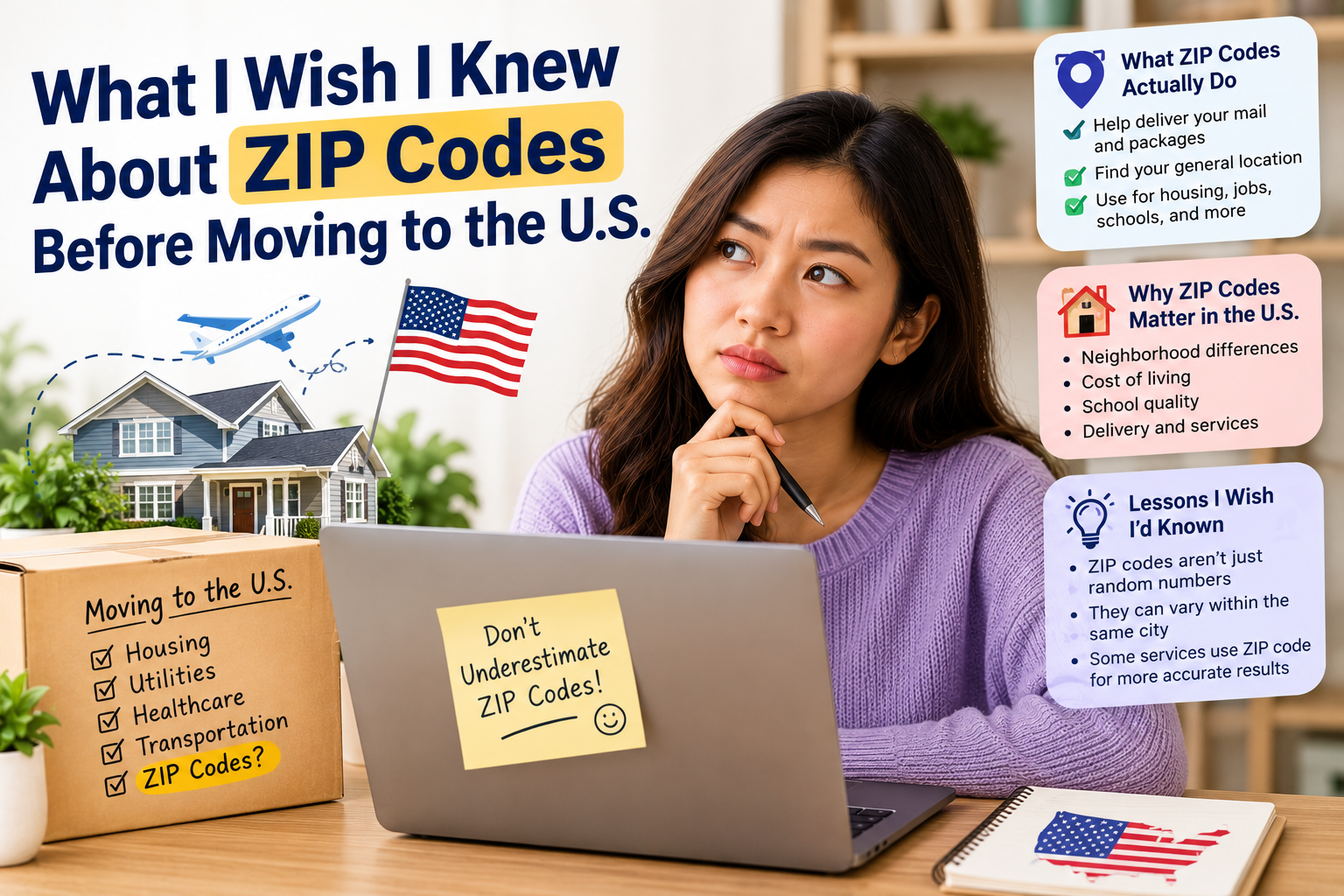
Before moving to the United States, I knew that American addresses used ZIP Codes, but I never really understood how important they could be. I assumed they were simply five numbers added to the end of an address to help mail reach the right destination.
Once I started dealing with addresses, deliveries, online forms, utilities, and local services, I realized that ZIP Codes were much more useful—and sometimes more confusing—than I expected.
If I could go back to my first days in the U.S., there are several things I would want to know beforehand.
A ZIP Code Is Not the Same as a City
One of the first things that surprised me was discovering that a city can have many ZIP Codes.
Before moving, I had imagined something like this:
City = One ZIP Code
The reality is different.
Large cities can have numerous ZIP Codes serving different neighborhoods and postal areas. Two addresses in the same city may have completely different ZIP Codes.
This became especially important when I was filling out forms. Knowing the city alone was not enough. I often needed the exact street address to identify the correct ZIP Code.
I Learned Not to Guess
One of my early mistakes was assuming I could figure out a ZIP Code based on a nearby address.
That was not always reliable.
Even locations that appear close on a map can have different ZIP Codes. Postal boundaries are designed around postal delivery and do not necessarily follow neighborhood or municipal boundaries.
Today, I would always verify a ZIP Code rather than guessing.
That simple habit can save time and reduce problems with deliveries and online orders.
ZIP Codes Appear Everywhere
Another surprise was how often ZIP Codes appeared in everyday life.
I encountered them when:
- Ordering products online
- Filling out registration forms
- Signing up for services
- Checking delivery options
- Looking for local businesses
- Providing billing information
- Searching for nearby locations
Before moving, I thought ZIP Codes mainly mattered for letters.
After moving, I realized they are part of many digital and physical systems.
Online Shopping Made ZIP Codes More Important
Shopping online quickly taught me another lesson.
Many ecommerce websites ask for a ZIP Code during checkout.
The information may be used alongside the street address to help process shipping, calculate delivery options, estimate certain costs, or determine whether services are available in an area.
This means entering the correct ZIP Code is important.
I became more careful about checking the complete address before placing an order, especially when buying something expensive or sending a package to a new location.
ZIP+4 Was New to Me
I had heard of five-digit ZIP Codes before moving, but I was less familiar with ZIP+4.
ZIP+4 adds four additional digits to the standard five-digit ZIP Code and can provide more specific postal information.
I initially wondered why anyone would need nine digits for an address.
After learning more about the system, I understood that additional postal detail can help distinguish delivery areas more precisely.
However, not every everyday form requires ZIP+4.
ZIP Codes Can Be Connected to Geographic Information
Another thing I found interesting was how ZIP Codes can be used as geographic references.
Depending on the database or tool, a ZIP Code lookup may provide information such as:
- City
- State
- County
- Time zone
- Latitude
- Longitude
- Nearby ZIP Codes
This made ZIP Code searches useful for more than mailing.
I could use them as a starting point when researching unfamiliar locations.
ZIP Codes Do Not Always Match Neighborhood Names
This was another source of confusion.
People often describe where they live using a neighborhood name, while official postal information may use a different city name or ZIP Code association.
That taught me not to assume that a neighborhood name and postal city are always identical.
When accuracy matters, I rely on the actual mailing address rather than trying to interpret the location from a neighborhood name alone.
I Learned to Keep My Address Information Organized
After dealing with several different forms and deliveries, I developed a simple habit.
I keep my complete address information readily available rather than relying on memory.
That includes:
Street address + City + State + ZIP Code
It sounds obvious, but it becomes useful when filling out multiple forms.
It also reduces the risk of accidentally entering a similar ZIP Code or making a typo.
ZIP Codes Can Be Useful for Finding Local Services
One of the more convenient things I discovered was using ZIP Codes to search for services nearby.
When looking for restaurants, stores, repair services, or other businesses, a ZIP Code can help narrow a broad search to a particular area.
It is not as precise as a complete street address or GPS location, but it can provide a useful geographic starting point.
I Became More Aware of Data Accuracy
Another lesson was that not every ZIP Code website provides exactly the same information.
Some websites offer simple lookup services, while others provide extensive geographic data.
For casual research, a basic lookup may be sufficient.
For important shipping or business purposes, however, I prefer information from a reliable source and verify critical details.
This became particularly important when I was dealing with unfamiliar locations.
ZIP Codes Are Part of American Daily Life
Perhaps the biggest lesson was realizing how deeply ZIP Codes are integrated into everyday American life.
They are connected to postal delivery, ecommerce, local searches, business services, geographic data, and many online forms.
Before moving, I saw ZIP Codes as an unfamiliar American addressing convention.
After living with them, I started seeing them as a practical tool for organizing location information.