
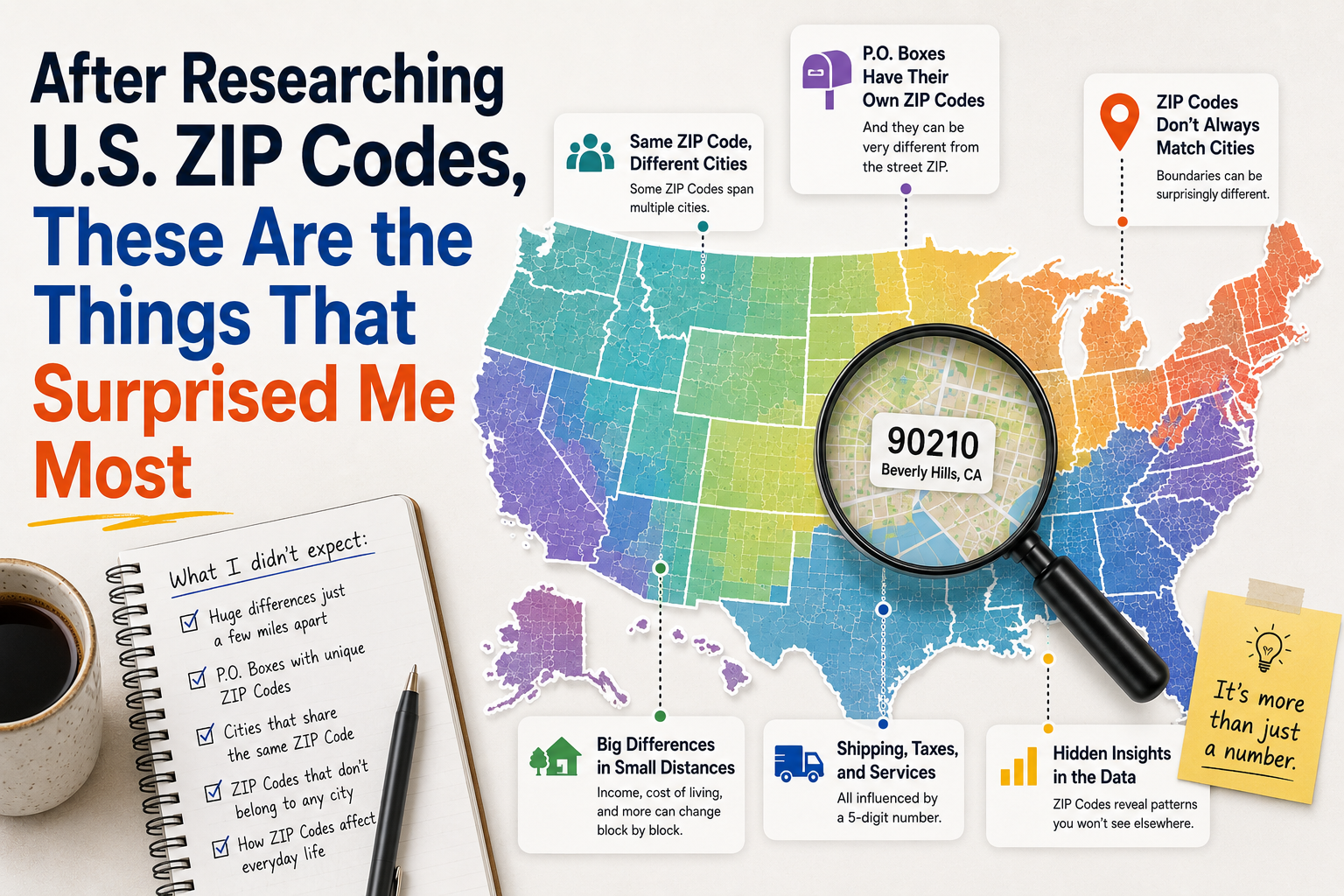
For a long time, I thought I understood the basic idea behind U.S. ZIP Codes. They were five-digit numbers placed at the end of a mailing address to help postal services organize deliveries. Simple, right?
Not quite.
After spending time researching how ZIP Codes work, I discovered that the system is much more interesting than I expected. ZIP Codes are connected to geography, businesses, ecommerce, logistics, databases, and everyday online services.
Some discoveries were particularly surprising.
I Was Surprised That ZIP Codes Are Not Exact Geographic Boundaries
My first surprise was realizing that a ZIP Code is not exactly the same thing as a neighborhood, city, or county.
I had assumed that ZIP Code boundaries would follow municipal boundaries neatly.
In reality, ZIP Codes are primarily designed around postal delivery.
Cities and counties, meanwhile, serve administrative purposes.
Because these systems were created for different reasons, their boundaries do not always match.
This explained why an address can sometimes have postal information that seems slightly different from what I would expect based on a traditional map.
One City Can Have Many ZIP Codes
I also discovered that large cities can contain many ZIP Codes.
Before researching the topic, I imagined that a city would usually have one primary ZIP Code.
That assumption quickly disappeared.
Large urban areas may contain numerous ZIP Codes covering different neighborhoods, business districts, and delivery areas.
This is one reason why knowing only the city is not always enough to determine the correct ZIP Code for an address.
The exact street address can be much more useful.
ZIP Codes Can Cover Very Different Geographic Sizes
Another surprising discovery was how much the physical size of ZIP Code areas can vary.
In densely populated cities, ZIP Codes can cover relatively small areas.
In rural regions, a ZIP Code may cover a much larger geographic area.
This makes sense when considering population density.
Thousands of addresses may be concentrated within a small urban area, while rural addresses can be spread across much greater distances.
The ZIP Code system has to accommodate both situations.
ZIP Codes Are Used Far Beyond Mail
I originally associated ZIP Codes almost exclusively with letters and packages.
Research changed that perspective.
ZIP Codes can appear in online shopping, local search, address verification, business databases, delivery services, and other digital systems.
When shopping online, for example, a ZIP Code may be requested during checkout to help process shipping and location information.
This showed me that ZIP Codes have become part of the digital infrastructure supporting modern commerce.
ZIP Codes Can Influence Online Shopping
One of the most interesting connections was ecommerce.
When entering a ZIP Code during checkout, I might think I am simply providing an address.
But location information can help websites determine shipping options, estimated delivery services, and other location-dependent details.
Depending on the retailer and system involved, geographic information may also contribute to certain cost or availability calculations.
It is fascinating that five digits can influence what appears on a checkout page.
ZIP+4 Adds Another Layer
I was also surprised by ZIP+4.
I had always thought of ZIP Codes as five-digit numbers.
Then I discovered that some addresses can use an additional four digits after the basic ZIP Code.
ZIP+4 provides more specific postal information.
It is not required for every everyday situation, but it demonstrates that the U.S. addressing system can contain more detail than the standard five-digit format suggests.
A ZIP Code Does Not Equal a GPS Location
Another important discovery was the difference between postal geography and precise location.
Some ZIP Code databases provide latitude and longitude information.
However, those coordinates may represent a general or central point associated with the ZIP Code rather than the exact location of every address within it.
That means I should not use a ZIP Code as though it were a precise GPS coordinate.
For navigation, a complete address or dedicated mapping system is more appropriate.
ZIP Code Numbers Are Not a Simple Distance Scale
I also learned not to assume that ZIP Codes with similar numbers are necessarily close together.
The numbering system follows broad geographic patterns, but the digits should not be interpreted as a direct measurement of physical distance.
A ZIP Code that differs by only one or two digits from another may not represent a location immediately next door.
This was a useful reminder that postal numbering and geographic distance are two different concepts.
ZIP Codes Can Help Businesses Understand Markets
Another unexpected use involves business analysis.
Companies can group customer information by ZIP Code to understand where their customers are located.
This can support marketing research, service-area planning, delivery operations, and other business activities.
For example, a local company might discover that a significant percentage of its customers come from a handful of nearby ZIP Codes.
That information could help the company make practical decisions about where to focus its services.
Data Quality Matters More Than I Expected
Researching ZIP Codes also taught me that the quality of the underlying data matters.
Different websites may provide different levels of detail.
Some may list basic city and state information, while others include county, geographic coordinates, time zone, and additional fields.
For casual searches, this may not be a major concern.
For shipping, business analysis, or important address verification, however, reliable and current information is much more valuable.
I became more cautious about accepting the first search result without considering its source.
ZIP Codes Connect the Physical and Digital Worlds
Perhaps the biggest surprise was realizing how strongly ZIP Codes connect physical locations with digital systems.
An online order begins on a screen.
A customer enters an address.
A payment is processed.
A warehouse prepares a package.
A carrier transports it.
Eventually, the package reaches a physical destination.
ZIP Code information can be part of that chain.
That makes those five digits more meaningful than I once thought.