
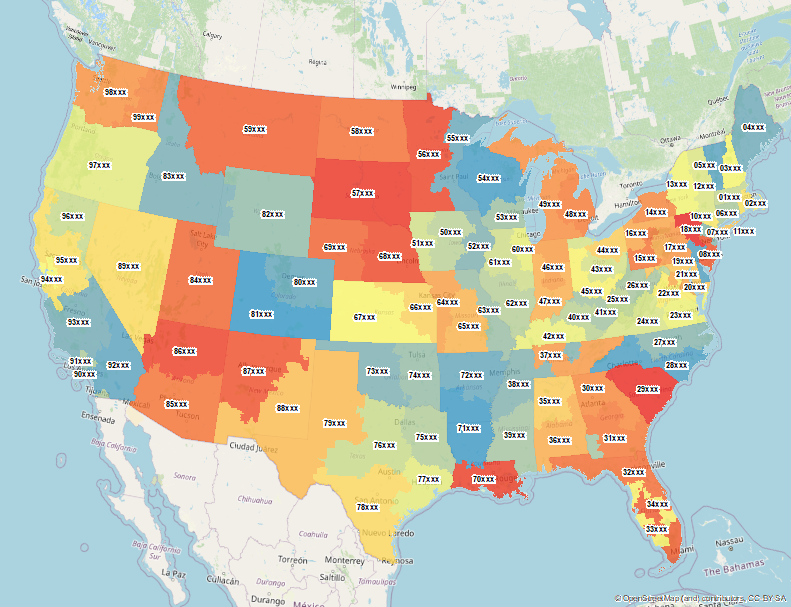
If you live in the United States or regularly send packages to American addresses, you have probably encountered a ZIP Code. You may see it when ordering something online, filling out a government form, sending a letter, or entering your address on a website.
Although a ZIP Code is only a short combination of numbers, it plays an important role in the U.S. mail and delivery system.
But what exactly is a ZIP Code? How does it work? What is the difference between a standard ZIP Code and ZIP+4? And how can you find the correct ZIP Code for an address?
This guide explains the U.S. ZIP Code system in a simple and practical way.
What Is a ZIP Code?
A ZIP Code is a geographic code used by the United States Postal Service to help organize and deliver mail.
The word ZIP stands for Zone Improvement Plan.
A standard U.S. ZIP Code contains five digits.
For example:
10001
ZIP Codes are assigned to geographic delivery areas rather than being simple identifiers for individual cities.
A single city can have multiple ZIP Codes, while a ZIP Code can sometimes cover areas associated with different communities or postal facilities.
Why Were ZIP Codes Created?
Before ZIP Codes became widely used, sorting large volumes of mail was more difficult.
As the population of the United States grew and Americans sent more letters and packages, the postal system needed a more efficient way to organize mail.
ZIP Codes helped postal workers and automated sorting systems identify where mail should go.
Instead of relying only on street addresses and city names, postal services could use a standardized geographic code to improve sorting and routing.
Today, ZIP Codes remain an important part of the U.S. addressing system.
How Does a U.S. ZIP Code Work?
A five-digit ZIP Code contains geographic information.
For example:
90210
The first digit represents a broad geographic area of the United States.
The following digits narrow down the location within the postal system.
In general, ZIP Codes progress from broad regions to more specific delivery areas.
However, it is important to remember that ZIP Codes are designed primarily for postal operations. They should not always be interpreted as precise political or geographic boundaries.
What Is ZIP+4?
In addition to the standard five-digit ZIP Code, the United States uses a more detailed format called ZIP+4.
A ZIP+4 code contains nine digits, normally displayed with a hyphen:
10001-1234
The first five digits identify the general ZIP Code area, while the additional four digits provide greater delivery precision.
The extra digits can help identify a specific segment of a street, building, group of addresses, or other delivery unit.
For everyday purposes, the five-digit ZIP Code is often sufficient, but ZIP+4 can provide additional accuracy.
ZIP Code vs ZIP+4
The difference is straightforward.
Standard ZIP Code:
10001
ZIP+4:
10001-1234
Both are part of the U.S. postal addressing system.
The standard five-digit version identifies the broader delivery area, while ZIP+4 provides additional detail.
You may encounter ZIP+4 on official correspondence, business mail, databases, and address verification systems.
Are ZIP Codes the Same as Cities?
Not exactly.
This is one of the most common misunderstandings about ZIP Codes.
People often assume that every city has one ZIP Code. In reality, many cities have multiple ZIP Codes.
A large metropolitan area can have numerous ZIP Codes because it contains many neighborhoods and delivery routes.
Similarly, a ZIP Code does not necessarily correspond perfectly to a city boundary.
This is why entering the complete street address is usually more reliable than trying to determine a ZIP Code from the city name alone.
Why ZIP Codes Matter for Online Shopping
ZIP Codes have become especially important in e-commerce.
When you enter a ZIP Code on an online store, the website may use it to determine:
- Whether a product can be delivered to your location
- Estimated shipping costs
- Delivery times
- Available shipping methods
- Local taxes
- Warehouse availability
- Delivery restrictions
For example, two customers living in different parts of the country may see different shipping options even when ordering the same product.
The ZIP Code helps the retailer understand the destination area.
ZIP Codes and Address Verification
Businesses also use ZIP Codes to verify addresses.
Banks, insurance companies, retailers, subscription services, and other organizations may request a ZIP Code when creating an account or processing a transaction.
In some situations, a ZIP Code can also be used as part of payment verification.
However, a ZIP Code alone is not enough to identify a complete address.
It works together with information such as the street, city, and state.
How to Find a ZIP Code
Finding a ZIP Code is usually easy if you have a complete address.
You can search using:
Street address + city + state
For example, instead of searching only for:
New York ZIP Code
you should use the specific street and location when possible.
This helps distinguish between multiple ZIP Codes within the same city.
A reliable ZIP Code lookup tool can then provide the appropriate result.
Why You Should Verify a ZIP Code
Entering an incorrect ZIP Code can create problems.
A wrong code may result in:
- Incorrect shipping calculations
- Address verification errors
- Delayed deliveries
- Incorrect delivery estimates
- Problems with online checkout
- Mail being routed incorrectly
Before sending an important package or submitting an address online, it is worth checking the ZIP Code carefully.
Common ZIP Code Mistakes
People make several common mistakes when entering ZIP Codes.
Entering the Wrong Number
ZIP Codes can look similar, especially when two areas are close to each other.
For example:
10001
and
10002
are only one digit apart but represent different ZIP Code areas.
Using a Neighboring ZIP Code
A nearby neighborhood may have a different ZIP Code.
Do not assume that a nearby code is acceptable simply because the location is close.
Forgetting Leading Zeros
ZIP Codes are treated as codes, not ordinary numbers.
Some ZIP Codes begin with zero.
For example:
02108
If a computer system treats the ZIP Code as a mathematical number, the leading zero could disappear.
That is why ZIP Codes should generally be stored and entered as text.
Confusing ZIP Codes With Area Codes
A ZIP Code is not the same thing as a telephone area code.
A ZIP Code is related to mail delivery.
A telephone area code is related to phone numbers.
These two systems serve completely different purposes.
ZIP Codes and Telephone Area Codes
This confusion is surprisingly common.
Consider the following:
ZIP Code: 02108
Telephone area code: 617
The first identifies a postal delivery area, while the second is associated with a telephone numbering region.
They should never be substituted for one another on a form.
ZIP Codes and States
ZIP Codes are also different from state abbreviations.
For example:
CA is the standard abbreviation for California.
A ZIP Code might be:
90210
An address may therefore contain both:
CA 90210
The state abbreviation identifies the state, while the ZIP Code helps identify the delivery area.
Both pieces of information are useful for properly formatted addresses.
Do ZIP Codes Change?
Yes, ZIP Code information can change.
Postal service requirements, population growth, new developments, delivery routes, and changes in postal operations can influence ZIP Code assignments.
New residential areas may also require adjustments to existing delivery structures.
This is why an old address database may occasionally contain information that is no longer current.
For important mail or shipping, it is best to verify the current ZIP Code.
ZIP Codes for Businesses and Organizations
Not every ZIP Code is primarily associated with residential addresses.
Businesses, government agencies, universities, large organizations, and other institutions may have dedicated postal arrangements.
Some organizations receive large volumes of mail and may use specialized ZIP Code information to help manage their deliveries.
This is another reason why ZIP Codes cannot always be understood simply as neighborhood identifiers.
ZIP Codes and Geographic Data
ZIP Codes are also widely used outside the postal industry.
Businesses can use ZIP Code data for geographic analysis, market research, delivery planning, customer databases, and service-area management.
For example, a company might analyze customer demand by ZIP Code to determine where to open a new store.
Real estate websites, insurance companies, retailers, and other organizations may also use ZIP Code information as part of their location-based services.
However, because ZIP Codes are postal delivery areas rather than exact geographic boundaries, they should be interpreted carefully in geographic analysis.
Can One ZIP Code Cover More Than One Community?
Yes.
A ZIP Code is not necessarily limited to one legally defined city or community.
Postal boundaries and municipal boundaries can be different.
This can occasionally create confusing situations where an address has a mailing city that does not perfectly match the nearby municipal boundary.
For this reason, address databases often need to consider multiple pieces of information rather than relying on ZIP Code alone.
What Is a ZIP Code Prefix?
The first digit of a ZIP Code provides broad geographic information.
The remaining digits make the location progressively more specific within the postal system.
For example, ZIP Codes beginning with similar digits may generally be associated with the same broad region.
However, the exact meaning of individual digits should not be treated as a simple map of state boundaries.
The U.S. ZIP Code system was created primarily to support efficient mail processing and delivery.
ZIP Codes in U.S. Territories
The U.S. ZIP Code system also covers certain U.S. territories and freely associated areas.
Their ZIP Codes can have formats that differ geographically from what someone might expect when looking only at the 50 states.
When sending mail to a U.S. territory or other special location, it is important to use the addressing instructions appropriate to that destination.
The Importance of ZIP Codes in the Digital Age
You might think ZIP Codes would become less important as communication moves online.
The opposite has happened in some ways.
E-commerce, digital address databases, delivery tracking, online forms, and location-based services have created even more situations where ZIP Codes are useful.
A ZIP Code can help a website determine where a customer is located without requiring the user to manually describe an entire geographic region.
It has become an important piece of data in both physical logistics and digital services.
How to Enter a ZIP Code Correctly
When filling out an online form, follow these simple steps:
1. Check the country.
Make sure the form is requesting a U.S. ZIP Code.
2. Enter the correct street address.
The street address helps identify the appropriate delivery area.
3. Confirm the city and state.
Make sure they match the address.
4. Enter all five ZIP Code digits.
Do not remove leading zeros.
5. Check for ZIP+4 requirements.
If the form specifically asks for nine digits, provide the ZIP+4 format.