
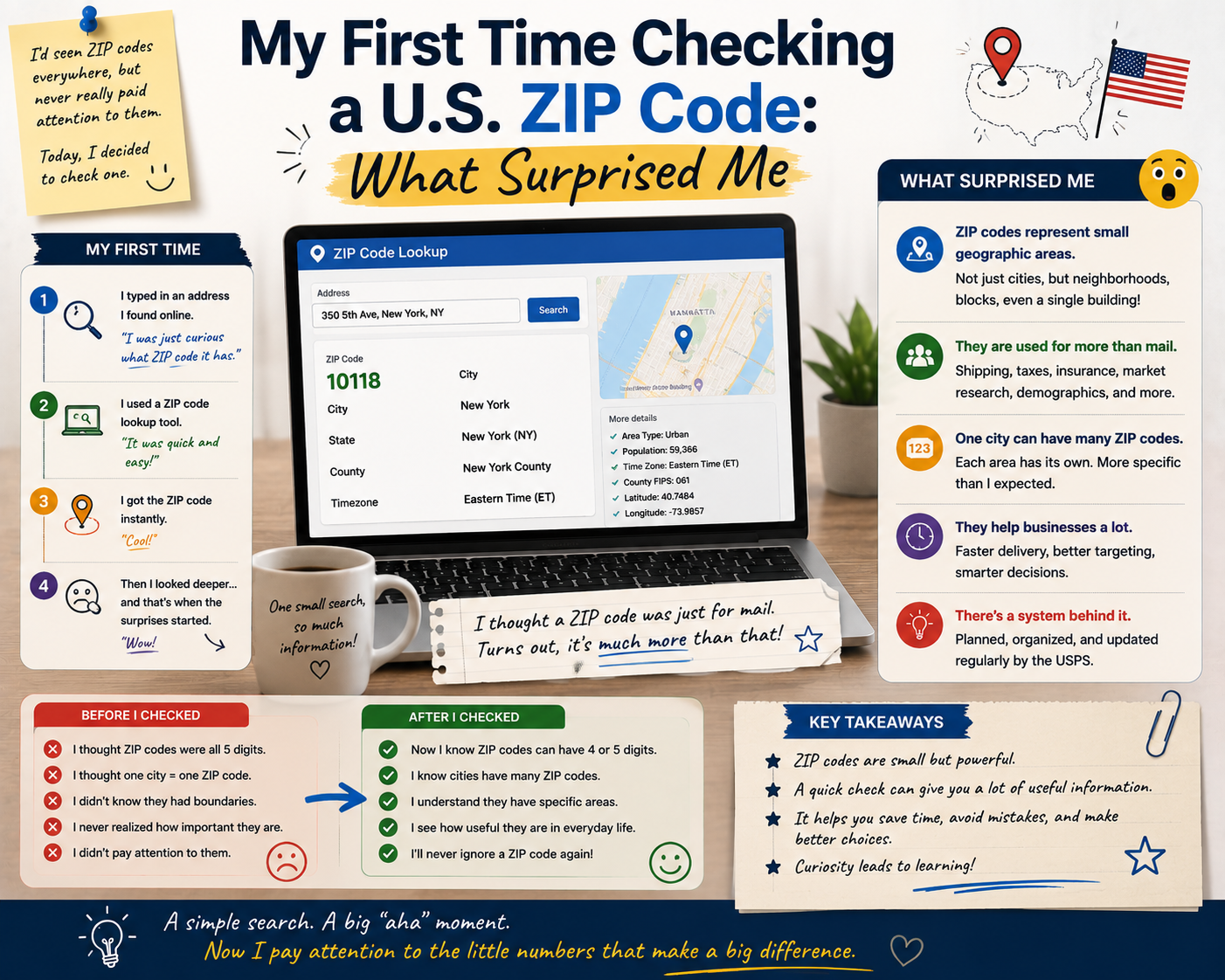
The first time I checked a U.S. ZIP Code, I expected the experience to be extremely simple. I assumed a ZIP Code was just a five-digit number attached to an address and that looking it up would tell me the city and state.
It did provide that information, but I quickly discovered that there was much more to the system than I had imagined.
What started as a simple search turned into an interesting lesson about American addresses, geography, mail delivery, online shopping, and the importance of accurate location information.
I Thought Every City Had One ZIP Code
The first thing that surprised me was discovering that a city can have multiple ZIP Codes.
Before doing my first lookup, I had unconsciously assumed that each city had one postal code. That assumption made sense from a basic perspective: one city, one ZIP Code.
The reality is very different.
Large cities can contain many ZIP Codes because different areas need to be served by different postal routes and facilities.
This immediately made me realize why guessing a ZIP Code based only on the city name could easily result in an incorrect address.
Five Digits Can Represent a Lot of Information
I was also surprised by how much information can be associated with a ZIP Code.
Depending on the lookup service and data source, a ZIP Code can be connected with information such as a city, state, county, geographic coordinates, time zone, and other location details.
The five digits themselves may look ordinary, but they can act as an entry point to a much larger set of geographic information.
That made the ZIP Code system seem much more sophisticated than I had previously thought.
ZIP Codes Do Not Always Match City Boundaries
Another surprising discovery was that postal boundaries and city boundaries are not necessarily identical.
When I first heard about ZIP Codes, I imagined them as neat geographic areas that followed municipal borders.
In practice, postal geography can be more complicated.
A ZIP Code may serve an area associated with a particular city name without perfectly matching the boundaries people see on a traditional city map.
This helped me understand why address databases sometimes contain information that looks slightly different from what I might expect based on a map.
Online Shopping Made More Sense
After learning more about ZIP Codes, I started noticing how frequently they appear in online services.
When ordering something online, entering a ZIP Code can be part of the checkout process.
It may help with address verification, shipping calculations, service availability, or other location-related functions.
Before my first ZIP Code lookup, I rarely thought about what happened after entering those five digits.
Now I understand that they can help digital systems determine where a customer is located and how an order should be processed.
I Learned Why Accuracy Matters
Another lesson was that a small mistake can have surprisingly large consequences.
Imagine entering a correct street address but using the wrong ZIP Code.
The rest of the address might look perfectly reasonable, but the conflicting information could potentially cause confusion during processing or delivery.
This made me more careful about checking addresses before submitting important forms or placing online orders.
Instead of assuming that a ZIP Code is correct because it looks familiar, I now prefer verifying it.
ZIP+4 Was Something I Had Never Considered
I was also introduced to ZIP+4.
I knew about five-digit ZIP Codes, but I had not previously paid much attention to the additional four digits sometimes used with them.
ZIP+4 can provide more specific postal information than the basic five-digit ZIP Code.
The discovery made me realize that even a system that appears simple on the surface can have additional layers designed to improve accuracy and efficiency.
ZIP Codes Are Useful for Businesses
My first lookup also changed the way I thought about businesses.
Companies can use ZIP Code information for practical purposes beyond mailing letters.
Businesses may use geographic information to understand customer locations, plan delivery areas, organize services, analyze markets, and determine whether certain products or services are available in particular locations.
For an online business serving customers across the country, ZIP Code data can therefore become quite useful.
I Started Seeing ZIP Codes on Maps Differently
Once I understood that ZIP Codes are connected to geographic areas, maps became more interesting.
I began looking at ZIP Code maps and comparing how different regions are divided.
Some areas have relatively few ZIP Codes, while densely populated regions can contain many.
This reflects the complexity of serving different communities and locations across a large country.
It also demonstrated that postal geography can tell us something interesting about how people and services are distributed.
Not Every ZIP Code Search Result Should Be Trusted Automatically
One of the more practical lessons was understanding the importance of data quality.
There are many websites that publish ZIP Code information, but the amount of detail and the reliability of the data can vary.
For casual research, a general lookup may be sufficient.
For important business, shipping, or address-related decisions, however, I would prefer a reliable and clearly sourced database.
A good ZIP Code website should also explain its data sources and provide information about updates when possible.
The Experience Changed a Small Habit
The most unexpected result of my first ZIP Code search was that it changed a small everyday habit.
I became more careful when entering addresses.
Instead of treating the ZIP Code as an insignificant number at the end of an address, I started viewing it as an important part of the location information.
That perspective is particularly useful in an increasingly digital world where addresses are entered into websites, mobile applications, ecommerce platforms, and delivery systems.