
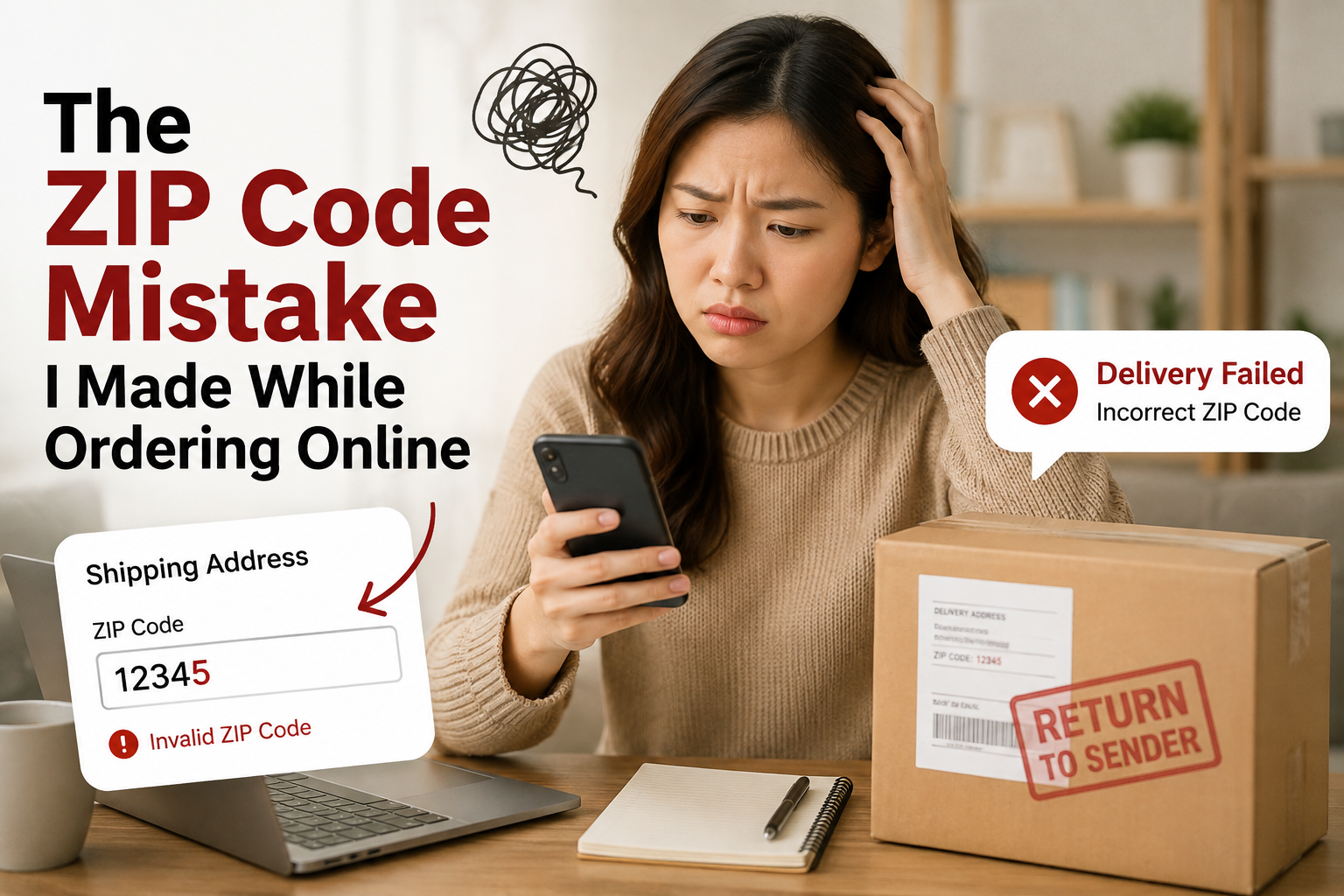
I used to think that entering a ZIP Code during online checkout was one of those simple steps that did not deserve much attention. The street address was what really mattered, I thought. As long as the house number and street name were correct, a small mistake in the ZIP Code probably would not make much difference.
I learned otherwise after making a surprisingly simple mistake while ordering something online.
It was not a dramatic experience, but it taught me an important lesson about address accuracy, online shopping, and why those five digits at the end of a U.S. address deserve more attention than I had given them.
The Order Seemed Completely Normal
The shopping process started like any other online purchase.
I found the item I wanted, added it to my cart, and proceeded to checkout. I carefully entered my name, street address, city, and state.
Then came the ZIP Code field.
I entered the number I believed was correct without checking it.
The checkout system accepted the information, and everything appeared normal. There was no obvious warning telling me that something was wrong.
I completed the order and moved on with my day.
At that point, I assumed the package would arrive without any problems.
The First Sign Something Was Wrong
A little later, I reviewed the order confirmation and noticed that something did not look quite right.
The city and state were correct, but the ZIP Code did not match the address I normally used.
I had accidentally entered a ZIP Code associated with a nearby area.
It was only a few digits, but those digits were part of the complete shipping address.
My first reaction was to wonder whether the order would still arrive.
After all, the street address was correct.
I decided not to panic and instead checked the retailer’s order-management options to see whether the address could still be changed.
Why I Had Made the Mistake
Looking back, the mistake was completely avoidable.
I had relied on memory.
The ZIP Code looked familiar, and because I had entered addresses many times before, I assumed I knew the correct number.
That assumption was the problem.
ZIP Codes can be surprisingly difficult to remember, especially when several nearby areas have similar postal information.
I realized that there was no good reason to guess when verifying a ZIP Code only takes a few moments.
The Experience Made Me Understand Address Verification
Before this incident, I had never really thought about how online stores process addresses.
During checkout, a customer may enter several pieces of information:
- Name
- Street address
- City
- State
- ZIP Code
These details work together to identify a delivery destination.
A ZIP Code is not simply an optional number placed at the end of the address.
It can be used by ecommerce systems and shipping services as part of address processing, delivery calculations, and location verification.
That made my mistake seem more significant than I initially thought.
I Started Checking Before Placing Orders
After that experience, I changed one small habit.
Whenever I enter an unfamiliar shipping address, I verify the ZIP Code before completing the purchase.
If I am ordering something for someone else, I ask them to confirm the complete address rather than assuming that I can determine it myself.
This takes only a few seconds.
It also gives me more confidence that the order information is accurate.
ZIP Code Errors Are Easy to Make
My mistake also made me realize how common small address errors can be.
People can accidentally:
- Enter one incorrect digit
- Reverse two numbers
- Use an old ZIP Code
- Choose a nearby ZIP Code
- Select the wrong city from an autocomplete menu
- Copy information incorrectly
These mistakes may seem minor, but they can create confusion during order processing.
The safest approach is to verify important information before submitting it.
Autocomplete Can Sometimes Create Confusion
Another thing I became more aware of was address autocomplete.
Many online checkout pages try to make the process faster by suggesting addresses as you type.
This can be convenient, but users still need to review the final information.
A suggested address may look correct at first glance, but it is worth checking the street, city, state, and ZIP Code before placing an order.
Convenience should not replace verification.
I Learned to Review the Confirmation Email
One of the most useful habits I developed afterward was checking the order confirmation immediately.
Previously, I would often close the confirmation page after seeing the payment and order number.
Now I look at the shipping information as well.
The confirmation email provides another opportunity to catch an error while there may still be time to contact the retailer.
This simple habit can prevent a small mistake from becoming a larger problem.
What I Would Do Differently
If I could go back to the moment I placed that order, I would take an extra minute to verify the ZIP Code.
I would also avoid assuming that a nearby ZIP Code is close enough.
Postal information should be treated as part of the complete address.
For important deliveries, I would verify the information using a reliable ZIP Code lookup or another trustworthy address source.
Most importantly, I would never rely entirely on memory.
The Lesson Was Bigger Than One Order
The interesting thing about this experience is that the mistake was not really about shopping.
It was about assumptions.
I assumed that I remembered the correct ZIP Code.
I assumed that the checkout system would catch an error.
I assumed that a nearby ZIP Code would not matter.
None of those assumptions was particularly helpful.
The experience reminded me that accuracy is often achieved through small habits rather than complicated technology.