
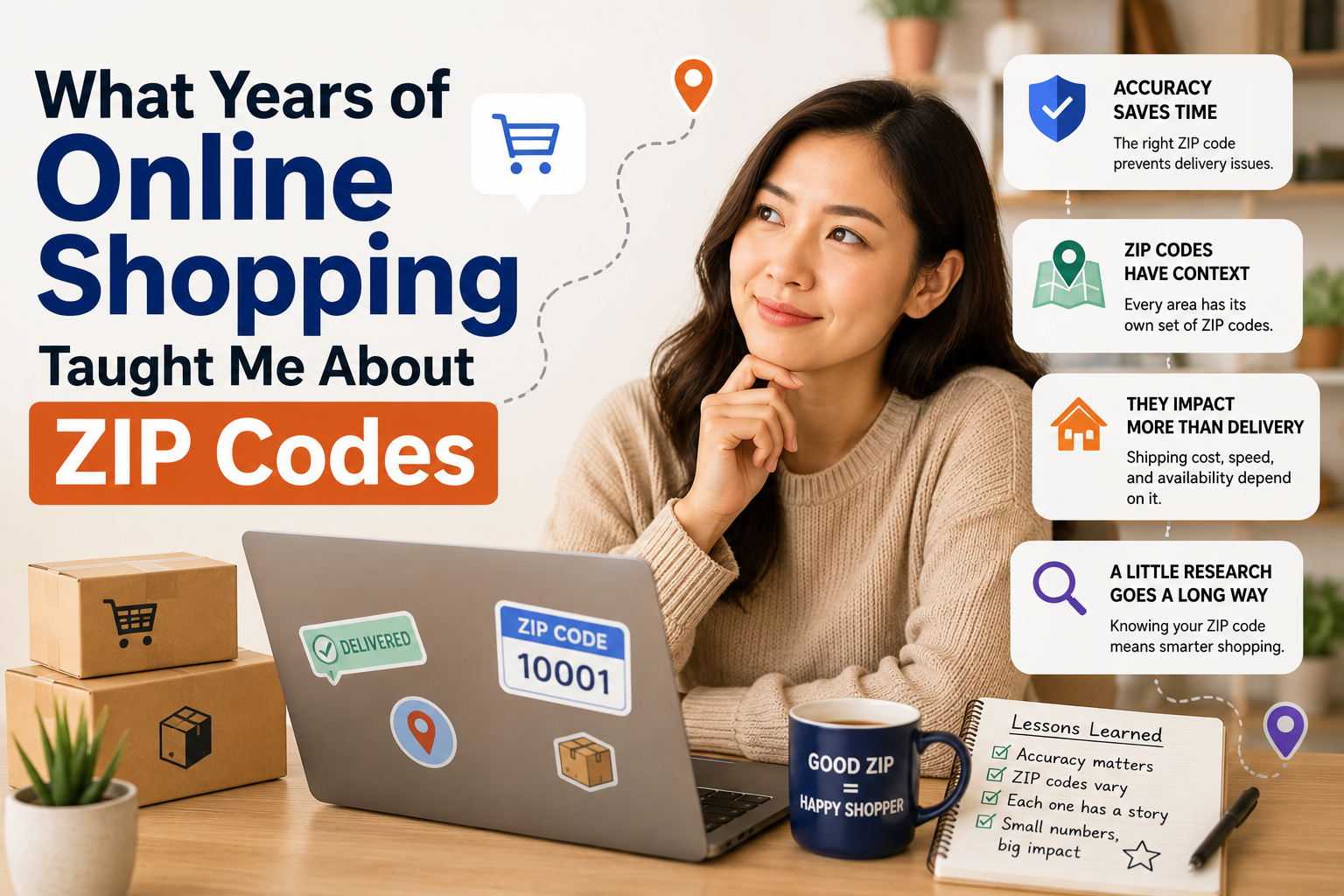
After years of shopping online, I realized that one small part of the checkout process had been quietly following me the entire time: the ZIP Code.
I entered it when ordering clothes, books, electronics, household items, and gifts. Sometimes I typed it from memory. Other times I checked an old address or looked it up. For a long time, I considered the ZIP Code just another box to complete before clicking the final payment button.
Eventually, I began to understand how important those five digits can be.
My experience with online shopping taught me several practical lessons about ZIP Codes, addresses, delivery, and the systems working behind an ecommerce checkout page.
I Learned That ZIP Codes Are More Than Postal Numbers
When I first started shopping online, I associated ZIP Codes almost exclusively with mail.
Over time, I noticed how many websites asked for them before showing shipping options, calculating costs, or completing an order.
That made me realize that ZIP Codes can play a role in digital commerce as well as traditional mail delivery.
An online store may use location information to determine whether it can deliver to an area, estimate shipping charges, calculate certain taxes, or display available services.
The ZIP Code may be only one part of that process, but it can provide useful geographic information.
I Stopped Guessing My ZIP Code
One of my earliest habits was entering ZIP Codes from memory.
That worked most of the time, but eventually I made a mistake.
The problem was not that I did not know my ZIP Code. It was that I typed too quickly and did not review the number before submitting the order.
That experience taught me that familiarity can sometimes create carelessness.
Now, whenever I am using an unfamiliar address, I verify the ZIP Code instead of guessing.
It takes less than a minute and provides much more confidence.
A Correct Street Address Does Not Mean Everything Is Correct
Another important lesson was understanding that an address contains multiple pieces of information.
A typical U.S. mailing address may include:
- Recipient name
- Street address
- City
- State
- ZIP Code
I used to focus almost entirely on the street address.
Now I understand that every part matters.
An incorrect ZIP Code can create an inconsistency even when the street address itself looks correct.
For important deliveries, checking the entire address is a much better habit than checking only one line.
Autocomplete Is Helpful, but I Still Check Everything
Modern shopping websites often make address entry easier with autocomplete.
I appreciate this feature because it saves time and reduces typing.
However, I have learned not to accept an automatically suggested address without reviewing it.
Autocomplete can select a different location from what I intended, especially when names are similar.
Before placing an order, I now check the street, city, state, and ZIP Code.
It takes only a few seconds.
ZIP Codes Help Explain Shipping Options
Over the years, I also noticed that shipping options can change depending on where an order is being delivered.
A website might display different delivery estimates or services after I enter my location.
This helped me understand why ecommerce companies need accurate geographic information.
Shipping is not simply about moving a package from one warehouse to another.
The destination affects routing, carrier selection, delivery schedules, and other logistical decisions.
A ZIP Code can be one useful piece of information in that process.
I Learned About ZIP+4
Online shopping also introduced me to ZIP+4.
I had always known the standard five-digit ZIP Code, but I rarely thought about the additional four digits.
ZIP+4 provides additional postal detail beyond the basic ZIP Code.
Not every online form requires it, and many ordinary addresses can be written using the standard five-digit format.
Still, learning about ZIP+4 made me appreciate how much detail can exist within the U.S. postal addressing system.
Different Cities Can Have Many ZIP Codes
Shopping online also made me more aware that cities can have multiple ZIP Codes.
When sending a package to someone in a large city, knowing only the city name is not necessarily enough to identify the correct ZIP Code.
Different areas may have different ZIP Codes.
That is why I became more careful when sending gifts or packages to friends and family.
I ask for the complete address rather than trying to determine the ZIP Code myself.
I Became More Interested in Address Verification
Eventually, I started paying attention to address verification tools.
These tools can help identify potential inconsistencies between street addresses, cities, states, and ZIP Codes.
For ecommerce businesses, this can be particularly useful.
Reducing address errors can potentially prevent unnecessary shipping problems and improve the customer experience.
As a shopper, I also appreciate websites that make it easy to review my address before completing an order.
Privacy Made Me Think Twice
Another lesson from online shopping was that ZIP Codes are also location-related information.
A ZIP Code generally does not identify a person’s exact home, but it can provide an approximate geographic area.
That means I am more conscious about sharing unnecessary personal information online.
I do not consider a ZIP Code extremely sensitive by itself, but I understand that location-related information can become more revealing when combined with other data.
What I Would Tell Other Online Shoppers
If my years of online shopping taught me anything about ZIP Codes, it is that accuracy is worth the extra few seconds.
Before completing an order, I now recommend checking:
Name → Street → City → State → ZIP Code
I also recommend reviewing the confirmation page or email after placing an order.
If something looks wrong, contacting the retailer as soon as possible is generally better than discovering the problem when the package is already in transit.