
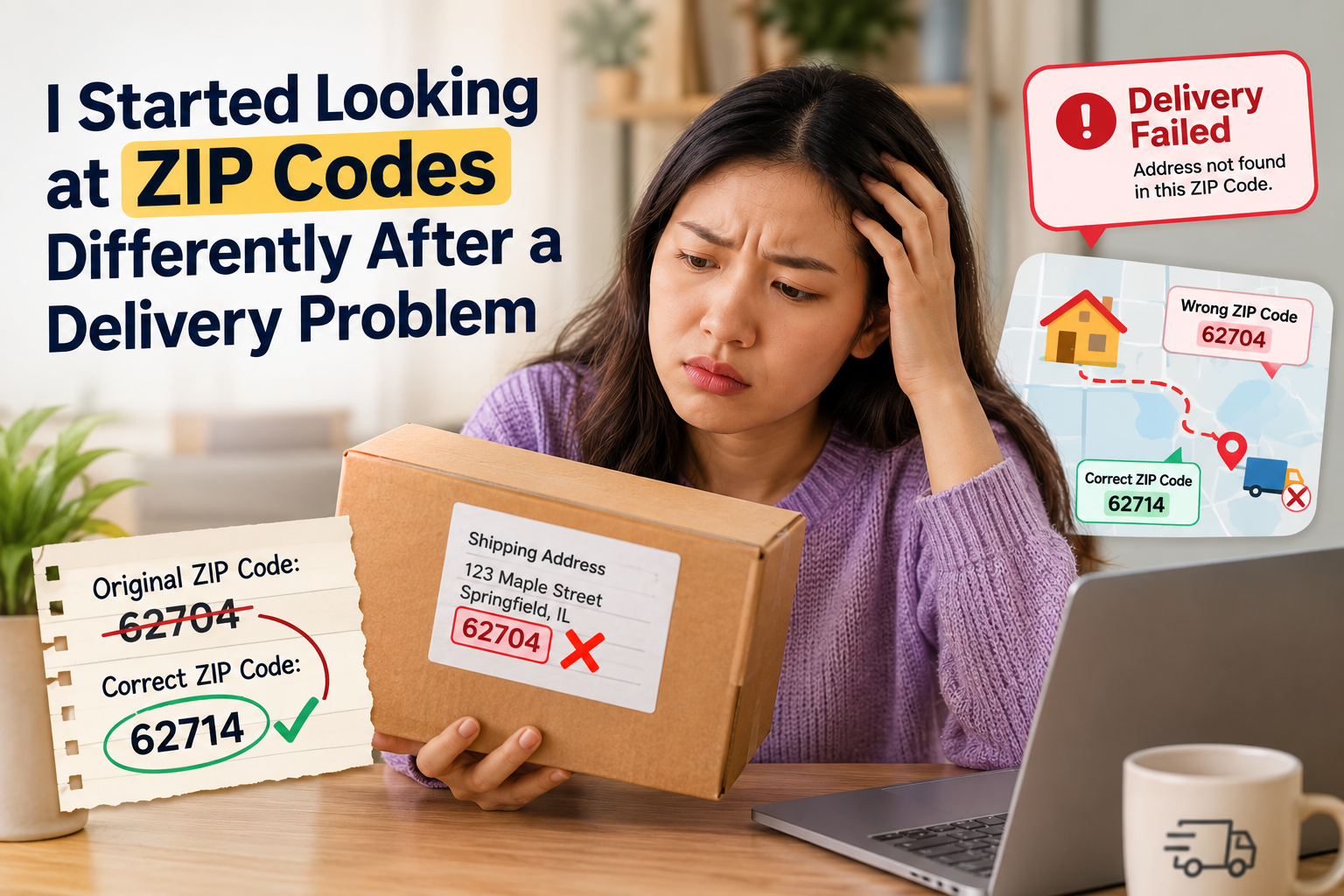
For years, I treated ZIP Codes as one of the least interesting parts of an address. Whenever I filled out an online order form, I entered the five digits almost automatically and moved on to the next field.
That changed after a delivery problem.
The package was not lost, and nothing dramatic happened, but the experience made me realize how much information is packed into a seemingly simple ZIP Code. It also taught me that accurate addresses require more attention than I had previously given them.
Since then, I have looked at ZIP Codes very differently.
The Order Started Normally
The order itself was routine.
I found something I wanted online, added it to my cart, entered my shipping information, and completed the purchase.
I carefully checked my name and street address but barely thought about the ZIP Code.
I was confident that I had entered it correctly.
The website accepted the address without displaying an obvious warning, so I assumed everything was fine.
Then the delivery estimate passed.
The Package Did Not Arrive When Expected
When the expected delivery date came and went, I checked the tracking information.
The package appeared to be experiencing a delay.
At first, I blamed the carrier.
Weather, transportation problems, high shipping volume, and other issues can affect delivery times, so I did not immediately think there was anything wrong with my address.
But after reviewing the order details, I noticed something I had overlooked.
The ZIP Code did not match the address information I normally used.
I had entered the wrong ZIP Code.
It Was a Small Mistake With a Big Lesson
The mistake was only one part of the address.
The street name was correct. The city looked correct. The state was correct.
Only the ZIP Code was wrong.
That made me realize how easy it is to assume that an address is correct simply because most of the information looks right.
A ZIP Code is not just decoration at the end of a mailing address.
It can be an important part of how shipping and address-processing systems understand a destination.
I Had Relied on Memory
Looking back, the biggest mistake was relying on memory.
I had entered the ZIP Code quickly because I thought I knew it.
I did not take a few seconds to verify the number.
That decision saved almost no time but created unnecessary uncertainty later.
Since then, I have changed my approach.
When I am entering an unfamiliar address, I verify the ZIP Code rather than guessing.
It is a small habit that can prevent a surprisingly frustrating problem.
I Started Paying Attention to ZIP Code Lookup Tools
After the delivery problem, I became more interested in ZIP Code lookup services.
I discovered that these tools can provide more than just a five-digit number.
Depending on the data source, a lookup may show:
- City
- State
- County
- ZIP Code type
- Time zone
- Geographic coordinates
- Nearby ZIP Codes
This information can be useful when trying to understand whether a ZIP Code actually corresponds to the location being entered.
I Learned That Cities Can Have Multiple ZIP Codes
Another discovery was that a city can have many ZIP Codes.
This seems obvious now, but it was not something I thought about before.
Large cities can contain numerous postal areas, and neighboring ZIP Codes may serve completely different streets or communities.
That means knowing the city alone is not always enough to determine the correct ZIP Code.
For shipping, the complete address remains important.
I Became More Careful With Autocomplete
Many online stores now use address autocomplete to make checkout faster.
It is convenient, but I learned not to assume that an automatically suggested address is always the one I intended.
After selecting an address, I now review the complete information.
I check the street, city, state, and ZIP Code before completing the purchase.
The few seconds spent reviewing the information are worth it.
The Experience Also Changed How I Send Packages
The lesson was not limited to online shopping.
When I send packages to friends or family, I now ask them to confirm their complete address.
I no longer assume that I can determine the correct ZIP Code simply from the city.
This is particularly useful when sending something to a new address.
It is better to ask one simple question than to discover later that a package has been delayed.
ZIP Codes Are Part of a Larger System
The more I learned, the more I understood that ZIP Codes are connected to a much larger infrastructure.
They are used alongside other address information by postal services, shipping companies, businesses, ecommerce platforms, and various digital systems.
A ZIP Code does not provide an exact GPS location, but it can provide valuable geographic and postal information.
That is why accuracy matters.
I Also Learned Not to Blame the Carrier Immediately
One unexpected lesson was about troubleshooting.
When a package is delayed, it is easy to immediately blame the shipping company.
Sometimes the carrier is responsible.
But my experience reminded me to check the information I provided first.
A delivery problem can have many possible causes, including incorrect addresses, incomplete information, processing delays, transportation issues, or other logistical circumstances.
Checking the original order details is a sensible first step.
My New Address-Checking Routine
Today, I have a simple routine whenever I place an online order.
Before clicking the final button, I check:
Name → Street Address → City → State → ZIP Code
After placing the order, I also look at the confirmation email.
If anything appears incorrect, I contact the retailer as soon as possible.
This routine takes very little time, but it gives me much more confidence.