
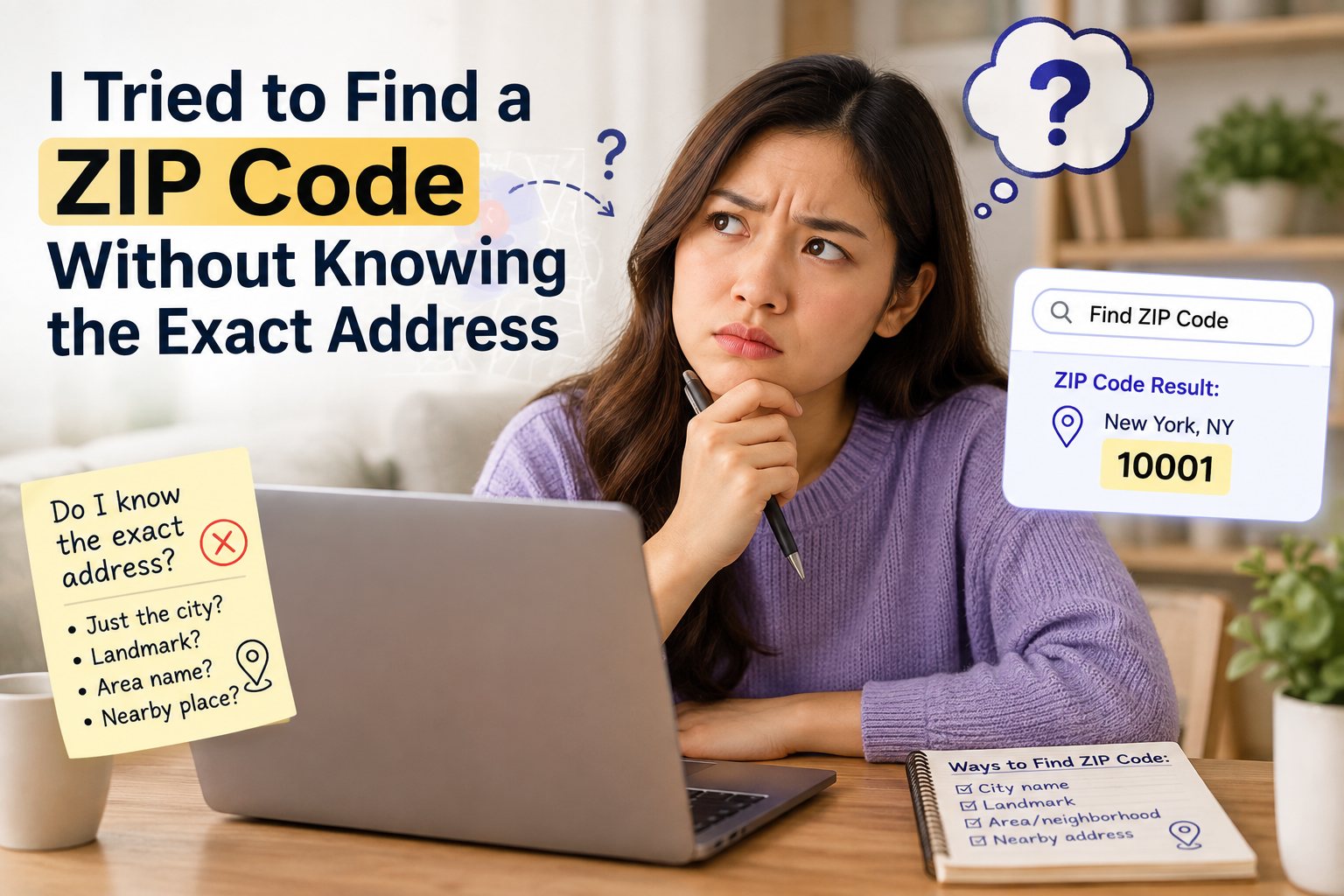
I used to think finding a U.S. ZIP Code required knowing an exact street address. If I did not have the house number or complete mailing address, I assumed there was not much I could do.
That assumption changed when I needed to find a ZIP Code while knowing only the city and state.
What started as a simple search became an interesting lesson about how ZIP Codes work, how location information is organized, and why finding a postal code is sometimes easier than finding an exact address.
The Situation Was Simple
I needed to find ZIP Code information for a location, but I did not have the complete address.
I knew the city and state, but I did not know the street name or house number.
My first thought was that I would need the full address before I could get a useful result.
Instead, I discovered that ZIP Code searches can often work in the opposite direction.
Rather than starting with an address and asking for the ZIP Code, I could start with a city and explore the ZIP Codes associated with it.
That was my first surprise.
I Started With the City
I entered the city and state into a ZIP Code lookup tool.
The result was not necessarily one single ZIP Code.
Instead, I found that the city could be associated with multiple ZIP Codes.
This immediately explained why my original assumption was incorrect.
A city does not always have one ZIP Code.
Larger cities can contain many ZIP Codes serving different neighborhoods, streets, business areas, and postal routes.
Without the exact street address, I could not necessarily identify one specific ZIP Code, but I could narrow down the possibilities.
Why Multiple ZIP Codes Make Sense
At first, seeing several ZIP Codes for one city seemed confusing.
Then I thought about the size of major American cities.
A large city can contain thousands or millions of residents, businesses, roads, neighborhoods, and buildings.
It would be unrealistic to expect one ZIP Code to handle every address.
Different ZIP Codes help organize postal delivery more efficiently.
This made me realize that ZIP Codes are designed around postal needs rather than simply matching city names.
I Learned the Difference Between a Search and a Verification
This was probably the most important lesson from the experience.
Finding ZIP Codes associated with a city is different from verifying the ZIP Code for a specific address.
If I know only:
Chicago, Illinois
I may be able to find many ZIP Codes associated with Chicago.
But if I need the ZIP Code for a particular street address, I need more information.
The exact address helps narrow the result.
This distinction is important when dealing with shipping, business records, online purchases, or official forms.
Nearby ZIP Codes Can Be Useful
Another useful discovery was the concept of nearby ZIP Codes.
Once I identified a general area, I could explore other ZIP Codes located nearby.
This can be helpful when researching a location without having an exact address.
For example, someone might know that a business is located in a particular part of a city but not know its street address.
Nearby ZIP Code information can provide additional geographic context.
However, I learned that proximity does not automatically mean two ZIP Codes serve the same neighborhood or address.
ZIP Codes Are Not Exact Coordinates
My experience also taught me not to treat a ZIP Code like a GPS coordinate.
A ZIP Code generally represents a postal delivery area or geographic grouping rather than a single precise point.
Some lookup databases may provide latitude and longitude associated with a ZIP Code, but those coordinates should not automatically be interpreted as the exact location of every address within that ZIP Code.
This distinction matters when using ZIP Code data for mapping or location analysis.
I Became More Careful With Online Forms
The experience changed how I think about online forms.
If a website asks for a ZIP Code and I only know the city, I no longer automatically choose the first result I see.
Instead, I check whether the form requires the ZIP Code for a specific address or simply needs a general location.
For shipping, billing, or identity-related information, guessing is not a good strategy.
For general research, however, city-level ZIP Code information can be perfectly useful.
Businesses Can Face the Same Problem
This situation is not limited to individual users.
Businesses may also work with incomplete address information.
A company might have a city and state but need additional information before determining the correct postal area.
ZIP Code databases and address verification systems can help narrow down possibilities, but accurate business records still require reliable address data.
This is particularly important for ecommerce, logistics, customer databases, and service-area planning.
The Importance of Reliable Data
One lesson I did not expect to learn was how important the data source is.
Different websites may display ZIP Code information in slightly different ways.
Some provide basic postal information, while others include geographic, county, time zone, or demographic details.
For casual research, a basic lookup may be sufficient.
For business or shipping purposes, however, I would want a source that clearly explains its data and keeps information reasonably current.
What I Would Do Next Time
If I needed to find a ZIP Code without an exact address again, I would follow a simple process.
First, I would identify the city and state.
Then I would search for the ZIP Codes associated with that location.
Next, I would narrow the possibilities using additional information such as neighborhood, street name, county, or nearby landmarks.
If the information were being used for an actual delivery, I would verify the complete address rather than relying on a general city-level result.
This approach is much safer than guessing.